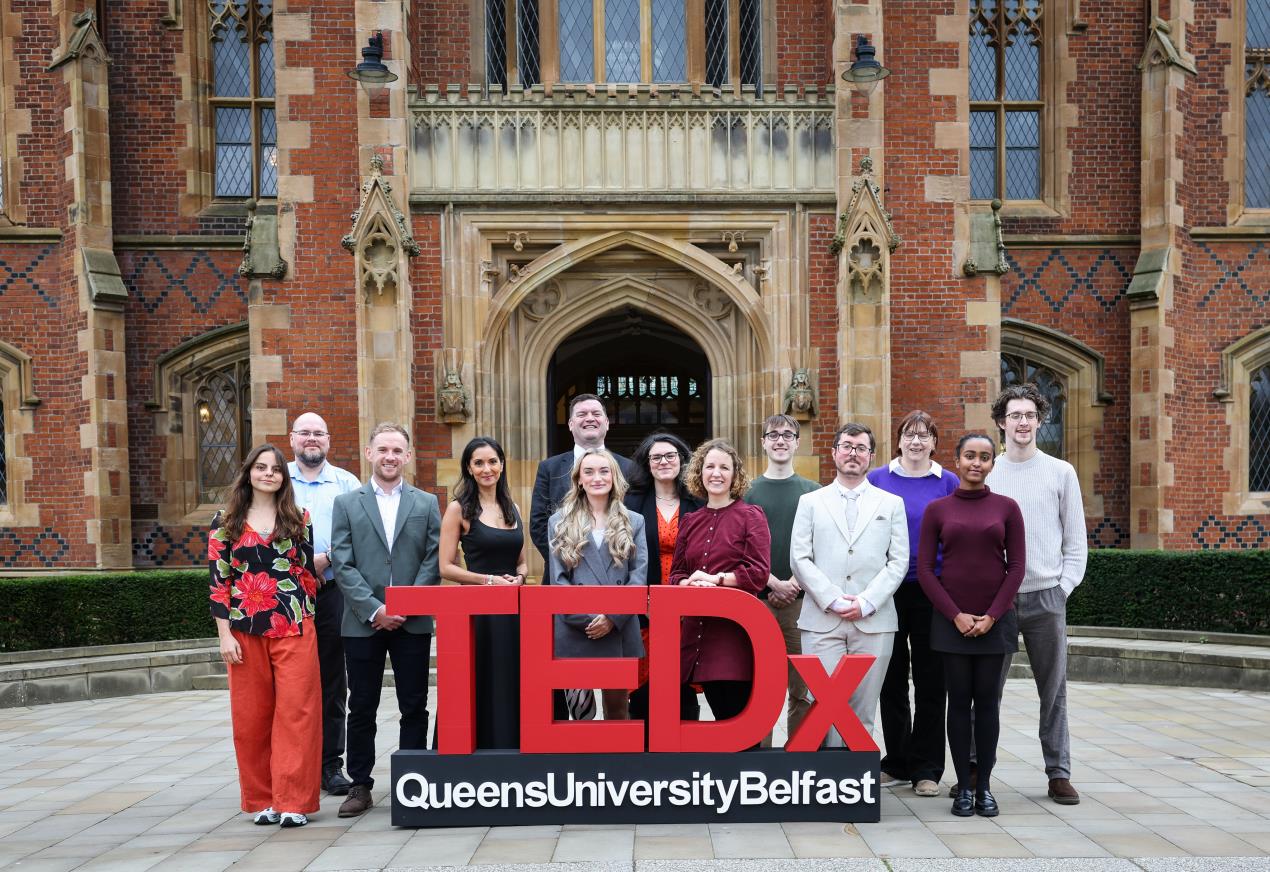

As artificial intelligence makes it easier than ever to create convincing fake images, videos and evidence, Queen’s will explore what happens when we can no longer trust what we see as part of the next series of TEDx at Queen’s University.
The future impact of digital privacy, disability inclusion, maternal mental health and environmental regeneration are also among the topics set to be explored at TEDxQueen’s University Belfast 2026.
This year’s theme “What If? What Next?” will bring together 12 speakers from academia, business and the community to examine the technological, social and ethical questions shaping the coming decade.
Among them is Professor Yvonne McDermott Rees, from Queen’s School of Law, who will warn that advances in AI and deepfake technology could undermine confidence in evidence used to investigate crimes and human rights abuses.
She said: “AI, and especially deepfakes, have the potential to spread disinformation, to alter our perceptions. With the advance of technology, mobile phone footage is often used as evidence of human rights abuses in court, but with the advent of AI and deepfakes, real footage can be undermined, so how do we deal with this moving forward?”
While some speakers will examine the risks posed by emerging technologies, others will ask whether innovation can be used more fairly and inclusively.
Dr David Cutting, from Queen’s School of Electronics, Electrical Engineering and Computer Science, will explore whether artificial intelligence will help bridge global inequalities or deepen them.
Drawing on years spent working on development projects in sub-Saharan Africa, he will argue that access to technology alone is not enough.
“AI has the potential to do enormous good and I hope that we as a society today can see that because of its potential and its power, it should not only be used responsibly, but fairly,” he said.
The event will also feature Bernadette Hagans, the Belfast entrepreneur and Queen’s alumna behind prosthetic fashion company Wrapsthetic. In her talk, she challenges assumptions about disability and questions why society so often associates disability with tragedy rather than opportunity.
Diagnosed with cancer while studying at Queen’s, Bernadette underwent a life-changing amputation at the age of 22 and has since built an international business centred on prosthetic customisation and disability advocacy.
She said: “When I started to tell people, they said things about how I could `hide’ my leg, but I thought – why would I want to do that? Having a disability isn’t something to be ashamed of, it’s a part of my story and I’ll proudly show my prosthetic leg.”
TEDxQueen’s University Belfast is part of the global TEDx programme, with more than 4,000 independently organised events taking place annually around the world.
Other talks will examine how sport could help tackle post-partum depression, whether personalised nutrition could transform healthcare, the hidden privacy risks buried in everyday photographs, environmental regeneration, scientific collaboration and what the stars can teach us about the legacy we leave behind.
Queen’s University Vice-President and Registrar Dr Ryan Feeney said: “In a period of rapid technological and social change, this year’s theme, ‘What If? What Next?’, feels particularly relevant. TEDx provides an opportunity to bring together people from different backgrounds to explore the ideas, opportunities and challenges that will shape our shared future.”
TEDxQueen’s University Belfast takes place on Wednesday 2 December at Riddel Hall. Admission is free and tickets are available via Humanitix.